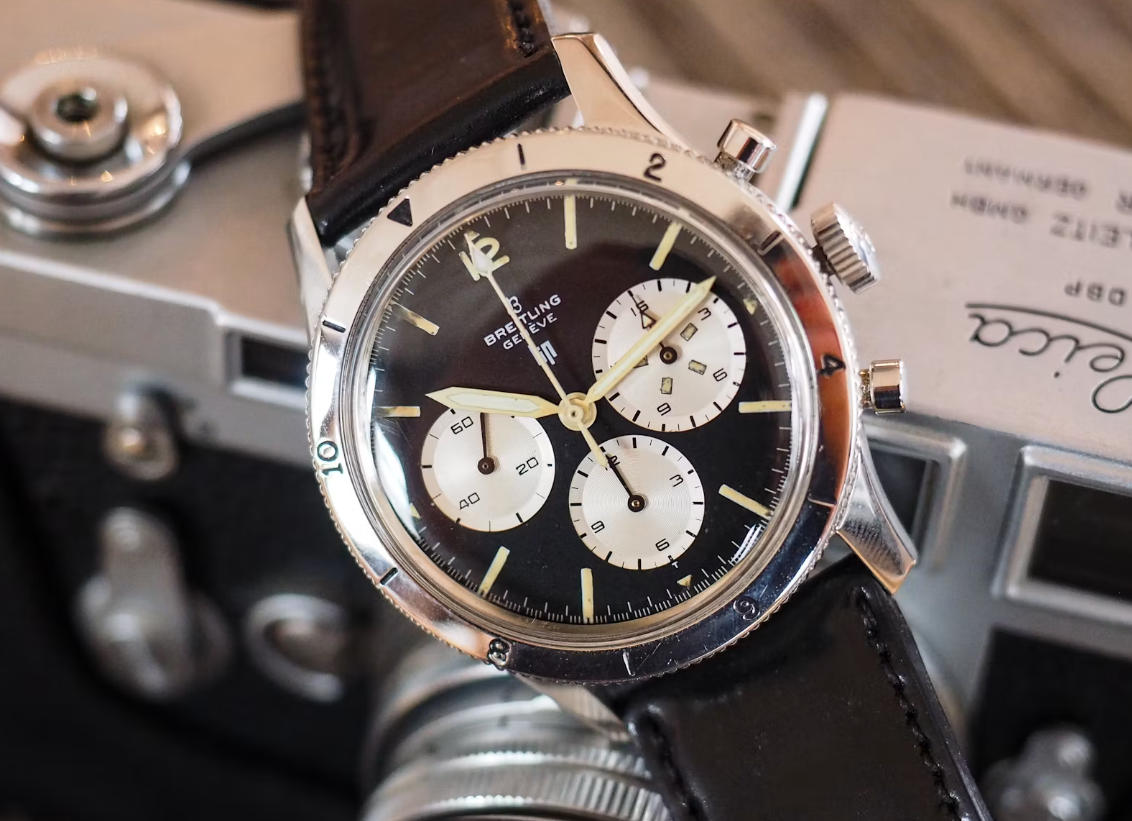
A 41mm chronograph does not sound especially large today. In 1953, it was a very different proposition.That is one of the reasons the Breitling Ref. 765 AVI remains so interesting. Long before large pilot watches became normal, Breitling produced a chronograph whose dimensions were driven by visibility and function rather than fashion. The watch that later became known as the Co-Pilot was deliberately easy to read, unusually substantial for its period and built around one very specific idea: a pilot should be able to understand elapsed time quickly.For readers following Breitling replica watches from a UK perspective, the Ref. 765 is also a useful model to study. It looks relatively simple compared with a Navitimer, but that simplicity leaves surprisingly little room for inaccurate proportions, incorrect subdials or generic vintage styling.
The AVI 765 began as a very different kind of Breitling
Breitling introduced the Ref. 765 AVI in 1953. At the time, the Navitimer was establishing its identity around the circular slide rule and the calculations associated with aviation. The AVI approached the same world from another direction.Instead of filling the dial with scales, Breitling concentrated on legibility.Large luminous Arabic numerals, a black dial, a rotating bezel and a substantial case made the watch easier to read at a glance. Breitling eventually referred to the model as the Co-Pilot, a name that suited its role alongside rather than in place of the Navitimer.The result was a watch that looked much more like an instrument than a piece of jewellery. That straightforward approach is one reason the vintage Breitling AVI Ref 765 design has aged surprisingly well.
The strange window at three o’clock was not a date
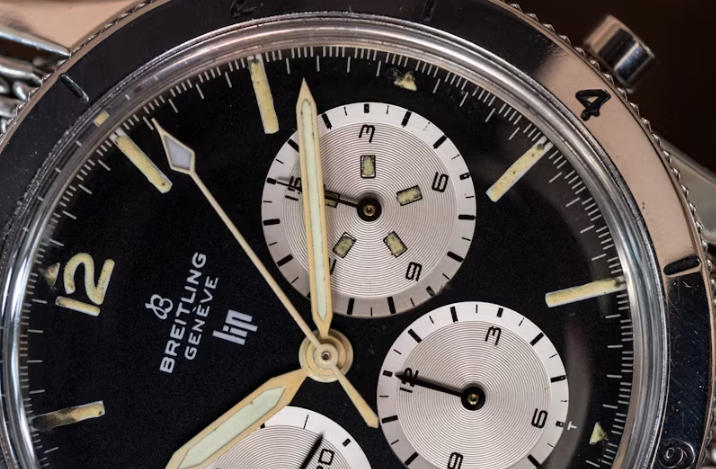
The earliest Ref. 765 AVI has one feature that can confuse anyone seeing it for the first time.At three o’clock sits a small window. On a modern watch, most people would immediately assume it contains a date. It does not.Breitling used the aperture to display elapsed chronograph minutes on a rotating disc. The display counted up to 15 minutes and was designed to make short periods of elapsed time particularly easy to read.This became one of the most distinctive features of the early AVI.Later examples also appeared with a more conventional analogue 15-minute subdial, so a Ref. 765 does not necessarily need the digital-style aperture to be historically correct. That distinction matters when identifying different executions of the watch.
Why 15 minutes mattered
The unusual chronograph display was connected to aviation rather than being added simply for visual effect.Early jet aircraft required carefully timed preparation and checks before take-off. A clearly visible short-duration counter therefore made practical sense in an aviation chronograph.The movement architecture had to accommodate this unusual display. Period Ref. 765 watches are closely associated with modified Venus 178 chronograph movements, while the conventional version retained the characteristic 15-minute timing function.For anyone studying a Breitling AVI 765 replica comparison, this history is important. A generic three-register chronograph with approximate dial placement may capture the broad appearance of the AVI while missing the reason its original dial was designed that way.
41mm was genuinely large in 1953
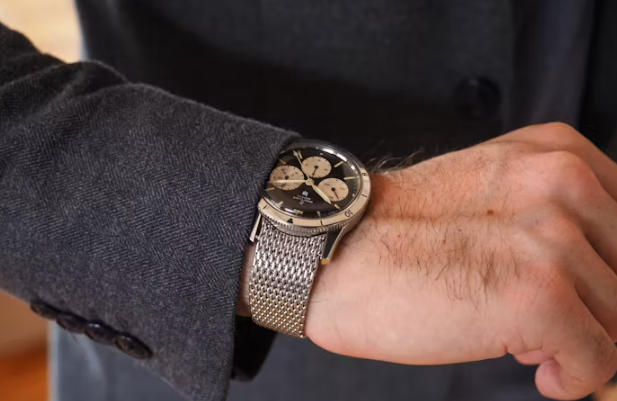
One of the easiest details to overlook today is the case diameter.The original AVI was approximately 41mm across, a size that now sits comfortably within the normal range for a sports chronograph. In the early 1950s, it was enormous by ordinary wristwatch standards.But the case does not look large simply for the sake of being large. The extra space allows the Arabic numerals, chronograph registers and bezel to remain visually separate from one another.That is why the proportions still make sense.The important lesson for replica comparison is that getting “41mm” into a specification sheet is not enough. Bezel width, dial opening, lug length and subdial diameter all contribute to the appearance of the original.A 41mm Breitling Classic AVI replica can technically have the correct diameter while still looking wrong if the dial occupies too little of the case or the bezel is excessively thick.
The bezel is more important than it first appears
The steel rotating bezel is a defining part of the early AVI architecture.Unlike the complex slide-rule system of the Navitimer, it provides a much cleaner visual boundary around the dial. Its engraved numerals also reinforce the instrument-like character of the watch.On a replica, bezel font, numeral depth and overall width are therefore useful comparison points.This is particularly important with vintage-inspired replicas, where manufacturers can sometimes rely too heavily on aged lume and distressed finishes while overlooking the actual proportions of the original hardware.
The AVI changed during the 1960s
The Ref. 765 did not remain frozen in its 1953 configuration.During the following decade, Breitling introduced contrasting subdials and the design gradually developed into the reverse-panda appearance that many collectors now associate with the Co-Pilot.By 1965, Breitling was using the Ref. 765 CP designation, with CP referring to Co-Pilot. The model’s appeal had also expanded well beyond professional aviation.Period examples became associated with figures including skier Jean-Claude Killy and actress Raquel Welch, who wore a Breitling Co-Pilot in the 1967 film Fathom.This matters because “AVI 765” does not describe one completely fixed visual configuration. When comparing a replica, the first question should therefore be:
Which historical Breitling 765 is it actually trying to reproduce?
Do not mix the 1953 watch with later reverse-panda versions
This is where many generic descriptions become misleading.An early 1953-style AVI with an all-black dial is not the same watch visually as a later 1960s reverse-panda Co-Pilot. The dial, bezel treatment and execution changed during the life of the reference.A replica can therefore contain individually plausible elements that do not belong together historically.For example, aged Arabic numerals may look convincingly vintage, but if the dial layout, bezel or hands belong to another period, the finished watch becomes a mixture rather than a faithful interpretation of one reference.Looking at the correct year and execution is more useful than asking whether a watch simply has a “vintage Breitling look”.
Breitling itself returned to the 1953 design
The importance of the original watch became especially clear when Breitling produced the AVI Ref. 765 1953 Re-Edition.The modern genuine re-edition uses a 41mm stainless-steel case, closely echoing the size of the historic model. Breitling also retained a domed Plexiglas crystal, an all-black dial and a 15-minute chronograph register.The current genuine watch measures 14.05mm thick and uses a 22mm lug width. Breitling rates it to 30 metres of water resistance.These figures are useful because the re-edition provides a modern factory reference for how Breitling itself interprets the proportions of the 1953 watch.
The modern B09 is not the original Venus movement
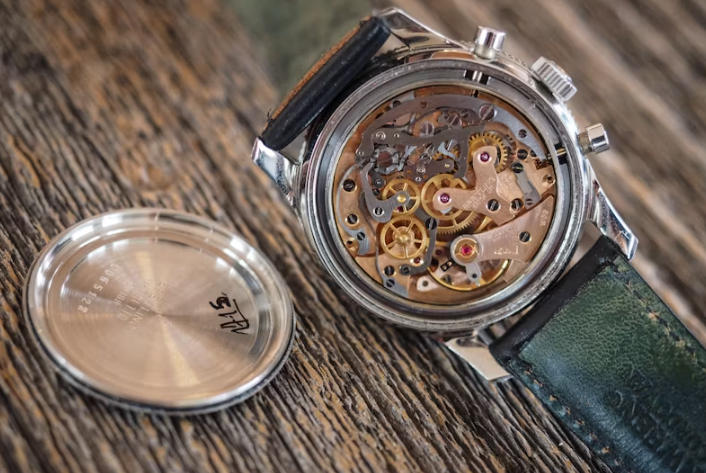
The movement distinction is just as important.Vintage AVI 765 watches are associated with the Venus 178 family, including versions modified for the unusual 15-minute chronograph display.Breitling’s modern 1953 Re-Edition instead uses the manufacture Calibre B09. It is a hand-wound chronograph movement based on Breitling’s modern B01 architecture and offers approximately 70 hours of power reserve.Those specifications belong to the genuine modern Breitling.They should not be copied automatically into the description of a replica.A Breitling AVI 765 replica movement may have a completely different architecture, power reserve and chronograph mechanism. It may also alter subdial positioning or case thickness.This is precisely why movement information should be treated separately from visual similarity.
What should you actually compare on a replica?
With the AVI 765, I would begin with proportion rather than branding.Look first at the relationship between the case, dial and bezel. Then examine the size and spacing of the Arabic numerals. After that, compare the chronograph registers, hands and minute counter with the specific historical execution being referenced.The most useful points include:
- case diameter and overall thickness
- bezel width and numeral style
- Arabic numeral proportions
- 15-minute chronograph layout
- subdial diameter and spacing
- hand length and shape
- crystal profile
- crown and pusher proportions
Aged-looking lume should come much further down the list.Artificial patina can create an immediate impression of age, but it cannot correct inaccurate architecture underneath.
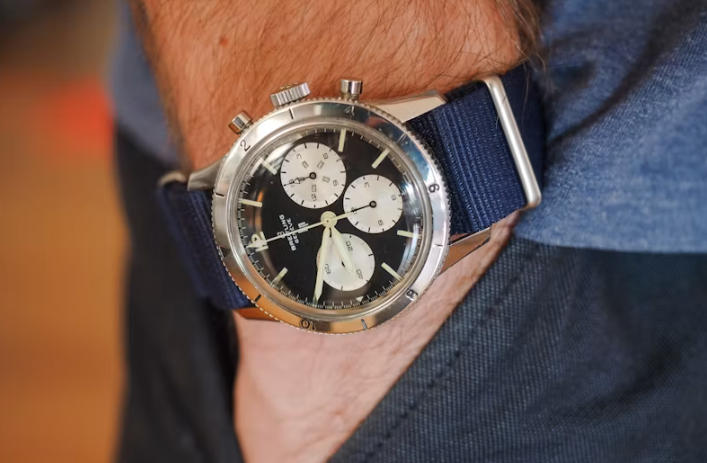
The dial should look functional before it looks vintage
This is perhaps the easiest principle to miss.The original AVI was not designed to look nostalgic. In 1953, there was nothing vintage about it.Its large luminous numerals and highly visible chronograph indications existed because Breitling wanted the watch to be easy to read.That means an accurate interpretation should first preserve clarity. Excessively dark “aged” lume, artificially distressed printing or exaggerated fading can actually move a replica further away from the character of the original.The best reference point is not an imagined sixty-year-old watch. It is how the AVI was intended to look when it was new.
Why the AVI 765 still looks contemporary
There is an interesting irony in the Ref. 765.It was unusually large in the 1950s because function demanded extra space. Modern tastes eventually caught up with those dimensions.Put a 41mm AVI alongside many current sports chronographs and the diameter no longer appears radical. What remains unusual is how clearly Breitling used that space.There is relatively little decoration. The bezel is functional, the dial is open and the typography is large. Even the unusual 15-minute counter had a specific job.That functional logic is why the design has survived better than many watches that were created primarily around the fashions of their own decade.
Where the Classic AVI fits into Breitling today
For UK readers who associate Breitling mainly with the Navitimer, the AVI family shows another side of the company’s aviation history.The Navitimer celebrates calculation and information density. The AVI is much more direct.That difference is worth understanding before comparing replica versions because the qualities that make one Breitling convincing do not automatically apply to another.You can explore more historical and modern references in our Breitling Classic AVI section, where the focus remains on case proportions, reference history and the details that separate individual generations.
The Breitling AVI Ref. 765 does not need a borrowed ownership story to be interesting.Its history already provides enough substance: an oversized 41mm aviation chronograph launched in 1953, an unusual 15-minute timing display, a design that evolved through the 1960s and proportions that feel far less extreme today than they would have seventy years ago.For replica-watch comparisons, the same history provides a useful standard. The important question is not whether a seller describes an AVI as “perfect” or “1:1”. It is whether the watch actually reflects a coherent Ref. 765 execution in its bezel, dial, chronograph layout, case and movement architecture.Once those details are understood, the appeal of the AVI becomes much easier to explain. It looks modern today largely because Breitling was unusually bold about function in 1953.